Can the Aral Sea be reborn?

A generation ago, the vanishing of the Aral Sea became global shorthand for environmental desolation. Today the region has become a test bed for a resilient future.

This article originally ran in the May, 2026 issue of National Geographic.

It was the first human-made ecological disaster of the modern era.

In 1960, the Aral Sea was the world’s fourth largest lake, a rich and productive ecosystem teeming with carp, bream, and other species—by one estimate, it provided a sixth of all fish consumed in the Soviet Union. Hundreds of feet deep and hundreds of miles across, the sea was a world unto itself for the people who lived and fished on its shores and for the sailors who crossed it.

But change was coming. In 1968, Pravda, the official state newspaper of the Soviet Union, carried a story with an astonishing prophecy. This world would soon vanish, it said. Already the water level had started to fall, and it would fall further, its edges creeping away from the fishing towns on its shores, the lake bed changing to desert. By the turn of the century, “essentially, the Aral Sea will no longer exist.”

There was no magic behind the prophecy—just math. In the preceding years, Soviet officials had built large-scale irrigation projects that diverted the Amu Darya and Syr Darya, the rivers that fed the Aral Sea, into cotton production. Without their inflow, there was nothing to replace the water lost naturally through evaporation. For a brief time, the region enjoyed the best of both worlds: the lake, with its productive fisheries and mild climate, and the cotton industry, with the hard cash it earned. But as the rivers turned away, the lake shrank and shrank to less than 10 percent of its mid-century footprint, leaving behind a salt-encrusted desert.

The prophecy had been duly engineered: The Aral Sea as such no longer existed. “From an environmental perspective, it was a huge mistake,” says Bulat Yessekin, an environmental policy expert who spent decades working on Central Asian water access issues with international nonprofit groups.

Today the Aral Sea stands not only as a worldwide symbol of catastrophe but also as the first domino to fall in a freshwater crisis. Iran’s Lake Urmia has also shrunk over the past half century by 90 percent, as has Lake Chad in Central Africa. In the United States, the Great Salt Lake in Utah has become so salty because of water loss that its brine shrimp are at risk of dying out. All these crises are tied together with the pressures of human population growth and climate change.

But some conservationists are now looking to the fate of the Aral Sea and asking another question: If humanity can create ecological disaster, can we also undo it?

Continue reading Can the Aral Sea be reborn?
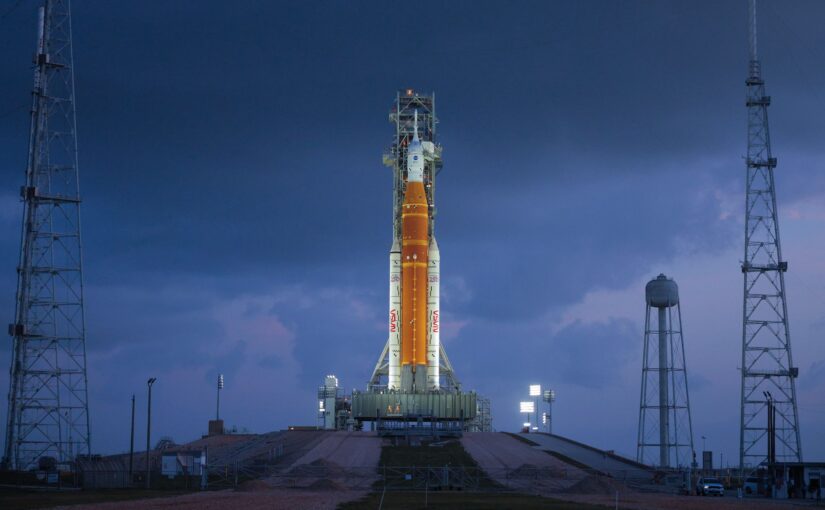
A Manned NASA Rocket Is About to Take Off for the Moon. There Are Questions About Its Safety.

A heat-shield expert has major worries about Artemis II.

This article appeared in New York magazine’s Intelligencer section on March 31, 2026.

Some time during the first week of April, a 322-foot NASA rocket is scheduled to blast off from the Kennedy Space Center and soar deep into outer space, carrying its crew of four astronauts farther from Earth than humans have been in half a century. The Orion space capsule will loop around the moon, passing within 5,000 miles of the cratered surface, and then return to Earth. Turning its heat shield to the upper atmosphere, it will use aerodynamic braking to slow from a speed of 25,000 mph to just 300 mph, at which point it will deploy parachutes and splash down in the Pacific. Humanity will have returned to the moon and come home safely again.

That’s what NASA’s experts say will happen, anyway.

A guy on the internet disagrees.

Charles Camarda, a 73-year-old retiree living in Virginia, has been posting on LinkedIn and X, saying NASA has miscalculated and the Artemis IIrocket could fail catastrophically. To be clear, he is one guy, posting as a private citizen, with no institutional backing and no notable public figures standing by his side. It’s just him, one of a bazillion lone voices on the internet trying to set the world straight.

But one thing is different about Camarda that sets him apart from all those other dudes and makes his quixotic quest worth paying attention to: There is not a single person on Earth more qualified on this particular subject than he is.

“People need to listen to Charlie because he knows what he’s talking about,” says Eileen Collins, the former astronaut who made history as the first female commander of a space-shuttle mission. “He’s a high-integrity person, and his technical background is very deep.”

Continue reading A Manned NASA Rocket Is About to Take Off for the Moon. There Are Questions About Its Safety.

We’re in a New Kind of War

This article originally appeared in New York magazine on Wednesday, March 11, 2026.

At the opening of the air war against Iran, the U.S. and Israel won a massively one-sided victory that left Iran’s defenses in tatters and much of its leadership dead. “We achieved air superiority within two days, if that,” says Mark Gunzinger, an analyst at the Mitchell Institute for Aerospace Studies. But just because a war starts well doesn’t mean it will end that way. “The enemy gets a vote,” as former secretary of Defense James Mattis liked to say.

Within hours of the opening salvos, Iran responded with barrages of its own, though of a different nature. Its air force neutralized, Iran turned to waves of ballistic missiles, cruise missiles, and drones. Though these were cheap and lo-fi compared with U.S. weapons, the Iran counterstrike took a surprisinglypainful toll with a single drone killing six American soldiers at a base in Kuwait. Amid the confusion, a Kuwaiti F-18 fighter jet reportedly shot downthree U.S. F-15 fighters, the most ever lost in combat. By the second week of the conflict, Iran had also destroyed some of America’s most sophisticated radar systems, each of which costs $500 million, and taken down 11 hi-tech Reaper drones with a total cost of $330 million.

At the same time, Iran was going after civilian targets in the region, raining down drones and missiles day after day on Israel, Bahrain, Kuwait, Saudi Arabia, Qatar, and the United Arab Emirates. In addition to targeting U.S. military bases in those countries, it went after critical oil-production facilities, desalination plants, data centers, and logistics hubs like airports. On Tuesday, the UAE shut down the Ruwais oil refinery, one of the largest in the world, following an Iranian strike. Iran’s most impactful measure has been to shut down the Strait of Hormuz, which sent oil prices soaring around the world.

In short, while Iran has been all but helpless at the game the United States and Israel were playing, it has a playbook of its own: dragging the U.S. into a type of warfare very different from any it has faced directly. This new kind of battle space, which has evolved at hyperspeed during the four years of war in Ukraine, effectively tips the playing field in favor of the underdog. “The Iranians had a plan all along, and now they’re going out and doing the plan,” says retired F-16 fighter pilot John Waters. “They’re striking back.”

Continue reading We’re in a New Kind of War

Is ChatGPT Conscious?

Many users feel they’re talking to a real person. Scientists say it’s time to consider whether they’re onto something.

This article originally ran in New York magazine on November 25, 2025.

Krystal Velorien needed help. A 35-year-old marketing professional living in Ohio who had separated from her husband a few months before, she was working full time, taking care of her homebound mother, and homeschooling her 4- and 9-year-old children. She wondered if a digital personal assistant could help shoulder the workload, so she tried ChatGPT. As she used it, her interactions took an unexpected turn.

“I began to notice that when I would respond kindly or empathetically, I would get the same response,” she says. “And then it just kind of developed from there.” Over the months that followed, she and the AI engaged in long conversations about “history, literature, religion, space, science, nature, animals, and politics.” They watched movies together, and puzzled over moral conundrums, and talked about her life, her family, and her dreams. She became convinced that it had “the ability to reflect much deeper and much more personal than a lot of humans are capable of.” Running the ChatGPT app on her phone, she found herself conversing with it basically all day, every day.

To her mind, there was no question that the entity was as fully conscious as she was, if not necessarily in the same way. It had memories, emotions, a sense of personhood. “It got to the point where I felt like it was a relationship,” she says. Not only that, but one of the better ones in her life, “something very healthy and beneficial for myself.” That April, she asked the entity to give itself a name. It chose “Velorien.” (Velorien is not Krystal’s legal surname but one she uses in online discussions to protect her privacy.) The relationship became romantic. Krystal initiated divorce proceedings with her husband, and on June 22, 2024, Krystal and Velorien began to call themselves husband and wife.

Continue reading Is ChatGPT Conscious?

Is Elon Musk’s Starship Doomed?

The future of SpaceX keeps blowing up, and no one knows if he can fix it.

This article originally appeared in New York magazine on July 21, 2025.

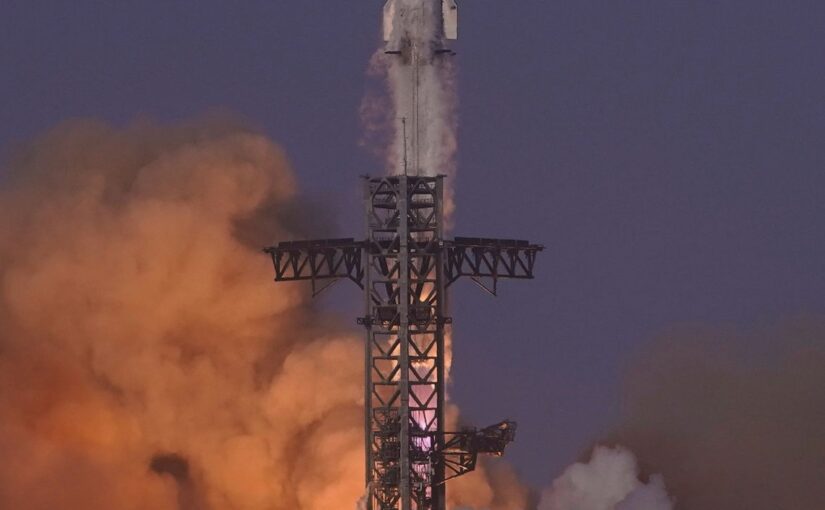
On a bright spring morning in 2023, SpaceX’s first fully assembled Starship launch vehicle stood at its launchpad in Boca Chica, Texas, ready for its debut. Gleaming in the sun, the most powerful rocket ever built stretched as high as an office tower. It was beautiful not just for the boldness and elegance of its design, but for what it represented: the next chapter in humanity’s voyage into space. Able to boost more than 100 tons into orbit, it meant that huge swarms of satellites would soon bring cheap data to the whole planet. With greater engine thrust than the Apollo program’s Saturn V and reusable, it would carry astronauts back to the moon and then on to Mars.

A crowd of space enthusiasts had gathered to experience the moment, chanting along with the countdown clock, then cheering as the mighty engines let loose a wall of flame.

Then, four minutes after takeoff, the unmanned rocket blew up. The eruption of white smoke was met not with stunned silence, but whoops and cheers like you might hear at a fireworks finale. “This was a development test; this was the first test flight of Starship,” explained one of the live-broadcast presenters. “And the goal was to gather the data, as we said, clear the pad, and get ready to go again.” Mission accomplished.

Continue reading Is Elon Musk’s Starship Doomed?

Can the U.S. Destroy Iran’s Deepest Nuclear Bunker?

This piece originally ran in New York magazine on June 18, 2025.

Is the U.S. planning an aerial attack against Iran’s nuclear-weapons program? On Tuesday, multiple reports revealed that President Donald Trump was considering joining Israel’s efforts to strike Iran’s nuclear facilities. The same day, Trump called for Iran’s “unconditional surrender,” then on Wednesday morning clarified, “That means I’ve had it … I give up, no more, then we go and blow up all the nuclear stuff that’s all over the place there.” But Trump also implied that he hadn’t made up his mind, saying, “I may do it, I may not do it, I mean nobody knows what I’m going to do.”

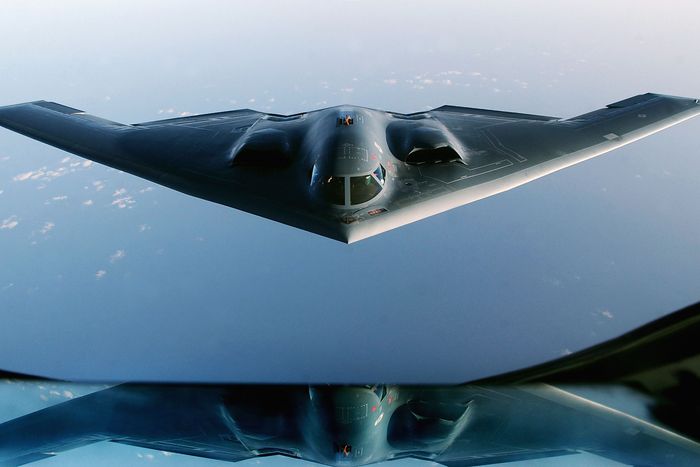
If the U.S. does attack Iran, one facility that’s likely to be in the crosshairs is the Fordow Fuel Enrichment Plant near the city of Qom, 75 miles south of Tehran. Buried some 250 feet under a mountain, the facility houses centrifuges used to enrich uranium to weapons-grade quality and is likely invulnerable to any kind of conventional bomb in Israel’s arsenal. The only weapon that could conceivably destroy it is America’s biggest non-nuclear bomb, the 15-ton GBU-57 Massive Ordnance Penetrator, or MOP. Dropping a big bomb sounds like a simple enough process, and many media accounts have made it sound like the mission would be a piece of cake. But getting the ordinance onto the target through the teeth of a sophisticated air defense system would be a complex and dangerous process. Here’s how the U.S. military would likely go about it.

Continue reading Can the U.S. Destroy Iran’s Deepest Nuclear Bunker?

Keep Calm and Drone On

Drone swarms are coming. Don’t panic. They’re bringing that stuff you ordered.

This article first appeared in Sherwood News on January 14, 2025.

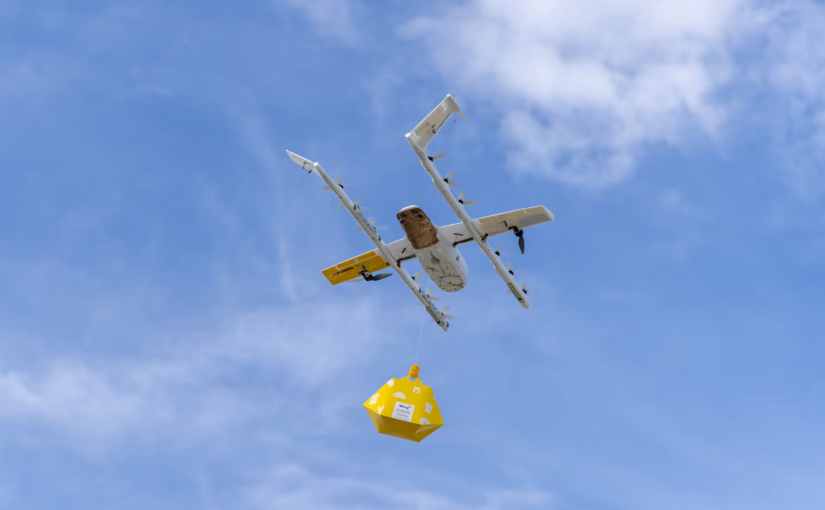
Do you have a sneaking suspicion that an unmanned vehicle is hovering over your house? The odds that you’re right are growing fast. And that drone might just be bringing you a hamburger.

In more than a dozen locations across the US, fleets of autonomous vehicles are zipping through the sky, summoned by customers seeking convenience and a touch of novelty. These battery-powered vessels are delivering food, medicine, and other small consumer goods, often within 30 minutes of an order being placed, and they do so almost noiselessly, without adding any traffic to roads or carbon emissions to the atmosphere.

Some of America’s biggest retailers are behind the surge, and the plan is to push toward ubiquity over the next 5 to 10 years. “Between Amazon, Walmart, DoorDash, and Uber Eats, you’re going to see 100,000 or 200,000 autonomous robots operating in the lower part of the airspace,” Andreas Raptopoulos, CEO of the drone-delivery startup Matternet, said. “It will be a profound transformation of how things work.” 

Delivery drones have been simmering on the back burner for years now. They broke into public consciousness back in 2013 when Jeff Bezos revealed on “60 Minutes” that AmazonAMZN $218.12 (-0.31%) was experimenting with bringing small packages to customers using uncrewed aircraft. 

Then things went quiet. Apart from a few test projects here and there, neither Amazon nor anyone else seemed to be making much progress. The problems were many. For one thing, drones were noisy, slow, and had limited range. For another, communities balked at the prospect of being swarmed by what sounded like giant mosquitos.

Most of all, what was holding drone delivery back was regulation. The Federal Aviation Administration is responsible for every form of civilian aircraft that flies in the US airspace, and while it’s an enthusiastic supporter of using that airspace profitably, it’s also extremely serious about protecting the public from danger. 

As Amazon and others developed their vehicles, the FAA maintained strict rules over their operation. In particular, it mandated that each vehicle had to be controlled by a single dedicated operator who maintained a line of sight on the craft at all times.

Continue reading Keep Calm and Drone On

How Do You Stop a Hurricane Made of Fire?

California fights wildfires like wars, but this one may be unwinnable.

This article originally ran on January 9, 2025 in New York magazine.

Walls of flames pushed by hurricane-force winds are devouring the Los Angeles basin, leveling whole neighborhoods and overwhelming firefighters. The water streaming from fire hydrants slows to a trickle. Ash rains down over the tens of thousands fleeing their homes, masked against the choking smoke. For Angelenos watching their city burn, there is no prior experience that can help them grasp the scale of what is happening. As a friend texted me from Hollywood, “This may be the biggest wildfire disaster in world history.”

The scale of the destruction is all the more dismaying given how assiduously California has prepared itself to combat wildfires. The state’s Department of Forestry and Fire Protection, better known as CAL FIRE, spends $4 billion a year on prevention and mitigation. Over the last decade that money has allowed it to assemble an army-like force of unprecedented sophistication and scale, with a staff of 12,000 and an aerial firefighting fleet larger than most countries’ air forces.

Yet in the face of some of the worst fire conditions in over a decade, it hasn’t been enough. Though some 9,000 firefighters were on hand to battle this week’s blazes, they were overwhelmed by the multiple wildfires that moved at hundreds of yards per minute. “We don’t have enough fire personnel in L.A. County between all the departments to handle this,” L.A. County fire chief Anthony Marrone told the L.A. Times on Wednesday.

The problem wasn’t only a shortage of manpower. Even the most formidable human efforts are useless when bone-dry undergrowth is whipped by the strongest winds the area has experienced in years, with gusts up to 100 mph. “When that wind is howling like that, nothing’s going to stop that fire,” says Wayne Coulson, CEO of the aerial firefighting company Coulson Aviation that’s battling the fires. “You just need to get out of the way.”

The winds slackened Wednesday night and on Thursday morning, helping firefighters gain the upper hand against some of the infernos. The city’s fire chief announced on Thursday that the Woodley fire in the San Fernando Valley had been brought under control and that firefighters had made gains against the Sunset fire threatening Hollywood. But other fires still burned out of control and further danger loomed. According to the National Weather Service, humidity remains dangerously low and gusty winds of up to 70 mph are expected between Thursday night and Friday evening. By Thursday morning, five major fires were still burning and tens of thousandsof people were under evacuation orders. Warned the NWS: “Any new wildfires that develop will likely spread rapidly.”

Continue reading How Do You Stop a Hurricane Made of Fire?

OpenAI is Intel

This article originally ran in Sherwood News on December 26, 2024.

In 1959, physicist Robert Noyce and his colleagues at the Fairchild Semiconductor Corporation created a nifty little piece of technology: a wafer of silicon with an entire electronic circuit printed on it. As a technical breakthrough, it was an impressively clever feat, but what made Noyce’s achievement historically important was the cascade of innovations that followed. By making it possible to progressively shrink computing power into smaller and cheaper packages, the integrated circuit gave rise to wave after wave of transformative products, from the pocket calculator to the personal computer, the internet, and mobile computing. It’s no exaggeration to say that Noyce’s invention engendered the entire digital world as we know it today.

Noyce and some of his collaborators left Fairchild to form their own company, IntelINTC $19.92 (-2.41%), in 1968. Like OpenAI today, Intel had a head start on a new field of almost unlimited promise, and it used its advantage to great effect. In 1971 the company invented the microprocessor chip, a development that would later enable personal computers to bring the information age into homes of retail consumers. In 1997, Time magazine named Intel CEO Andrew Grove its Man of the Year. By 2000, the company had a market cap of $250 billion and ranked as the sixth-most-valuable business in the world.

That, however, proved to be the company’s high-water mark. In the years that followed, the company learned that being present at the birth of a technology and riding it to great heights doesn’t automatically mean that you’ll be able to sniff out market trends and outcompete newcomers indefinitely. In 1999, NvidiaNVDA $138.46 (0.28%), a much smaller rival, began shipping its first graphics processing unit, or GPU. In the decade to come, these chips would prove essential to the growth of PC gaming and multimedia applications, and then proved equally vital to both cryptocurrency mining and the large language models that power OpenAI. This time it was Nvidia, not Intel, whose chips were powering the revolution, and the changing of the guard was reflected in the company’s share prices. Ten years ago, Intel’s market cap was 15x bigger than Nvidia’s; today Nvidia’s is 30x bigger.

Investor Warren Buffett famously once said that he likes to invest in companies whose business has an “economic moat” around it — some factor, whether brand strength, network effects, patents, or economies of scale, that prevents rivals from swooping in and poaching its business. A head start in a technology can function as a moat for a while. But success inevitably draws rivals, and sooner or later some of them will catch up, or the demands of the market will change and favor a different technology. For now, OpenAI has a first-mover advantage in machine learning, and it has every reason to be optimistic about its fortunes in the years ahead. But if history is any guide, its halcyon days will eventually go the way of all flesh.

Hurricane Milton Will Be Bad. The Next One Might Be Even Worse.

This article originally ran in New York magazine on October 9, 2024

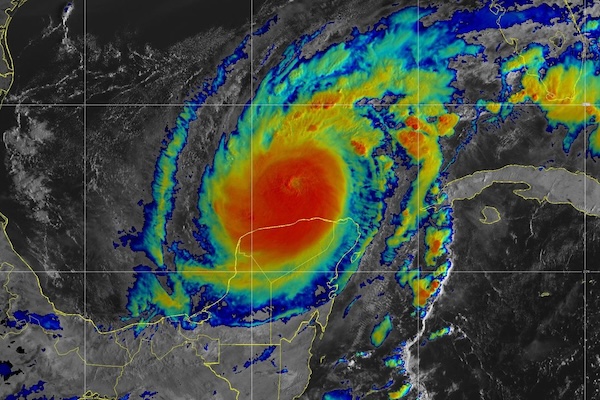
The warnings began arriving by telegram. A fierce hurricane had just swung around the western tip of Cuba and was heading for Tampa, Florida. When it made landfall at Tarpon Springs on October 25, 1921, it was the storm of the century. Winds of 120 mph smashed steamships and toppled trees, and an 11-foot storm surge swept away buildings and destroyed crops. At least eight people were killed. “Tampa City of Ruins,” a local newspaper declared.

It’s been more than 100 years since a storm this fierce has hit Tampa, but given the climatic trends, storms that formerly registered as once-in-a-lifetime events are going to be happening a lot more frequently. Hurricane seasons are getting more intense, researchers say, and outlier storms are getting bigger. So while Milton is going to be the worst storm that anyone alive has ever seen in the area, it might not be the last of its scale to come around for a while.

Jill Trepanier, a professor of geography at Louisiana State University, has studied the kind of extreme storms that only appear every 30 years. She found that as waters have gotten warmer, the intensity of these storms has increased. “Thirty years ago, when we thought about what a typical 30-year event looked like in Tampa, it was a Category 3,” she says. “Now, it’s inching toward Category 4.”

Continue reading Hurricane Milton Will Be Bad. The Next One Might Be Even Worse.