This piece originally ran in New York magazine on June 18, 2025.
Is the U.S. planning an aerial attack against Iran’s nuclear-weapons program? On Tuesday, multiple reports revealed that President Donald Trump was considering joining Israel’s efforts to strike Iran’s nuclear facilities. The same day, Trump called for Iran’s “unconditional surrender,” then on Wednesday morning clarified, “That means I’ve had it … I give up, no more, then we go and blow up all the nuclear stuff that’s all over the place there.” But Trump also implied that he hadn’t made up his mind, saying, “I may do it, I may not do it, I mean nobody knows what I’m going to do.”
If the U.S. does attack Iran, one facility that’s likely to be in the crosshairs is the Fordow Fuel Enrichment Plant near the city of Qom, 75 miles south of Tehran. Buried some 250 feet under a mountain, the facility houses centrifuges used to enrich uranium to weapons-grade quality and is likely invulnerable to any kind of conventional bomb in Israel’s arsenal. The only weapon that could conceivably destroy it is America’s biggest non-nuclear bomb, the 15-ton GBU-57 Massive Ordnance Penetrator, or MOP. Dropping a big bomb sounds like a simple enough process, and many media accounts have made it sound like the mission would be a piece of cake. But getting the ordinance onto the target through the teeth of a sophisticated air defense system would be a complex and dangerous process. Here’s how the U.S. military would likely go about it.
1.Gather the assets
Taking out a deep bunker requires a very special set of tools, of which even the United States has very few.
One is the bomb itself. Built by Boeing and first delivered to the Air Force in 2011, the MOP is basically an enormous explosive charge inside a thick metal casing that can withstand the impact of hitting a rock or concrete fortification at high speed and then burrow deep into the ground.
“If you just explode on the surface, the energy will mostly just deflect,” explains Tom Karako, a fellow at the Center for Strategic and International Studies. “It might cause a little bit of surface damage, but it will mostly deflect, even if it’s a big explosion. And so you need to penetrate the rock so as to have the explosive energy reverberate. You need to crack the mountain.” The resulting shock wave can implode tunnels and chambers.
The number of MOPs that the U.S. possesses is classified, but they are not very numerous. The initial delivery was for just 20 bombs. None has been used before in combat, as far as is publicly known.
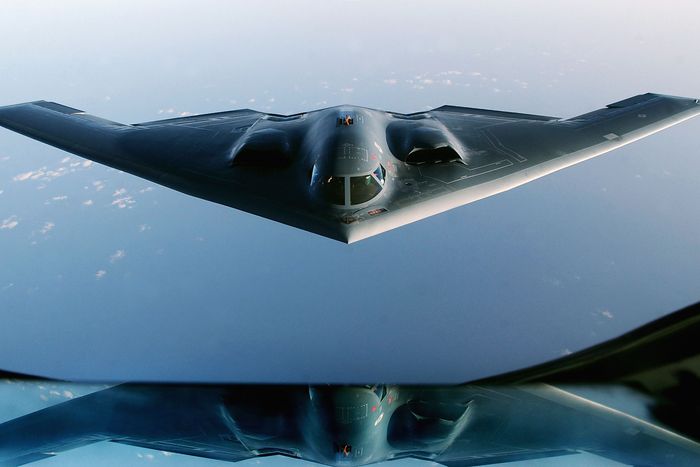
Each individual MOP bomb is so huge that the only operational U.S. aircraft that can carry it is the B-2, currently the most advanced bomber in the U.S. arsenal. Not only does the aircraft’s shape and special coating make it nearly impossible to detect by radar, the heat of its engines is dispersed so that it is hard to track in the infrared spectrum as well. It’s still visible to the eye, of course. “That’s why we tend to operate stealth aircraft at night,” says Mark Gunzinger of the Mitchell Institute for Aerospace Studies.
Because of its top-secret anti-radar coating, the B-2 requires special climate-controlled hangers. There is only one facility in the world capable of hosting the 19 B-2s currently in operation: Whiteman Air Force base in Missouri. To strike the facility at Fordow would require a round-trip flight of 14,000 miles.
The B-2s can’t operate alone. They need support aircraft like the KC-135 Stratotankers and KC-46 Pegasuses to provide inflight refueling. On Sunday a flight-tracking website reported that 31 of the aircraft were heading eastwards from the United States.
2.Soften the defenses
Iran is an ally of Russia and deploys some of the Kremlin’s post potent air defence assets, including sophisticated radar systems and a range of formidable surface-to-air missiles, including the S-300PMU-2 long-range missile and the locally made Khordad 15 medium-range missile. These could pose a significant threat even for an aircraft as sophisticated as the B-2.
Their effectiveness, however, has been substantially reduced since June 13, when Israel began its ongoing campaign against Iranian air defense assets, including strikes on surface-to-air missiles and fighter aircraft on the ground. “They’ve hit about six air-defense radars so far, probably more,” says Thomas Withington, an associate fellow at Britain’s Royal United Services Institute (RUSI). Israel also used cyberattacks to disrupt data links between Iranian missiles, radar, and command centers. “The Israelis have run an absolute textbook operation. They’ve done exactly what you should do, and they appear to have done it very effectively,” Withington says.
In military terminology, this kind of operation is called an Offensive Counter Air (OCA) campaign. “You clear the air defenses on the routes that you want to use, so that you’ve got a relatively unimposed way of getting to and from your targets,” he says.
As a result of Israel’s successful campaign, says Douglass Barrie, a senior fellow at the International Institute for Strategic Studies, “Iran’s capabilities have been depleted markedly.” In any future attack on Iranian nuclear facilities, the U.S. would likely enjoy air superiority, meaning that it could operate without significant hindrance from Iran.
But defenders could still be able to exact a price. “There is always the possibility of a combat loss of an aircraft,” Barrie says.
3.Roll in heavy (or in this case, fly)
Once it has committed itself to carrying out an attack, the U.S. style of military operation is to hit with overwhelming force. “The way the U.S. likes to do stuff is to unleash an amazing amount of firepower, punch your way through any air defenses that are protecting that site so the B-2s can come in, unleash hell, and then fly back out again,” says Withington.
Inbound bombers would be preceded and accompanied by fighter escort as well as electronic warfare aircraft like the EA-18G Growler that can jam Iranian air defense radars and a “Wild Weasel” aircraft that can detect and destroy those radars by “throwing an air-to-surface munition like a bomb or missile down the radar’s throat,” Withington says.
For the mission to succeed in destroying the buried nuclear facility, the bombers will have to get in close. Weapons like cruise missiles can be fired from many hundreds of miles away, but not a huge weapon like the MOP, which uses the energy gained in freefalling from high altitude to penetrate deep into the ground. It’s equipped with wings that are not for flight but for steering so that the bomb can home in on a target that attackers have illuminated with a laser beam. So to reach the target, the MOP has to be dropped from quite close — “You have to get within 10 or 15 miles to deliver them, depending on the altitude,” Gunzinger says.
4.Be prepared to hit it again
The bunker at Fordow might be so deep, and buried under so much rock, that even the MOP can’t break through. If that’s the case, the Air Force might try to break through by dropping a second MOP into the hole left by the first one.
“Multiple GBU-57/B impacts would almost certainly be required to reach the Fordow Fuel Enrichment Plant, with the second bomb impacting inside the hole made by the first,” says Justin Bronk, a senior research fellow at RUSI. “While each B-2 can carry two GBU-57/Bs, such an attack would require redundancy since the weapons would have to function and be delivered perfectly to get down into the facility and explode at the right depth to cause critical damage.”
Hitting the exact spot multiple times in succession would be an impressive feat but it’s one that the MOP is well capable of. “It’s very accurate,” Gunzinger says.
5.Deal with the consquences
An attack against Fordow could have costly repercussions for the United States, as it could leave Iran feeling obligated to hit back in some fashion. On Wednesday, Iran’s supreme leader, Ayatollah Ali Khamenei, declaredthat “The Americans should know that any U.S. military intervention will undoubtedly be accompanied by irreparable damage.”
The United States has service members deployed to numerous bases in the Middle East that lie within range of Iranian missiles. American intelligence officials reportedly believe that Iran has already begun preparing missiles and other weapons for retaliatory strikes.
And even if a U.S. air strike against Fordow is 100 percent successful, that doesn’t mean that the U.S. will have succeeded in thwarting Iran’s nuclear ambitions. In a recent piece on the RUSI website, Justin Bronk writes that Iran’s nuclear expertise involves too large a community of scientists, dispersed too broadly across the country, to be taken out via air strike. “Following any military strike on its nuclear sites, Iran not only has the requisite indigenous expertise but will also have increased incentive to rebuild, and to rebuild deeper and more hardened facilities,” he writes. “Destruction of Iran’s nuclear programme by military means is not feasible.”
Israel is apparently hoping that its ongoing air campaign will not only hobble Iran’s nuclear weapons program but that it will lead to the collapse of the Islamic Republic’s regime. There aren’t many historical examples of an air campaign leading to regime change, however.
“The clock is ticking on whether Israel will be able to make a timely impact not merely on the nuclear facilities but, frankly, on the regime itself,” says Karako. “You can fail to destroy everything on the nuclear side, but you get rid of the regime, it’s a different equation. But if you don’t get rid of the regime and you fail, then you’ve potentially just emboldened and irritated them.”
@jeffwise : It seems you don’t receive comment notifications anymore. Could you please take a look at this ?
https://www.deepdivemh370.com/p/30-a-777-pilot-weighs-in/comment/79214319