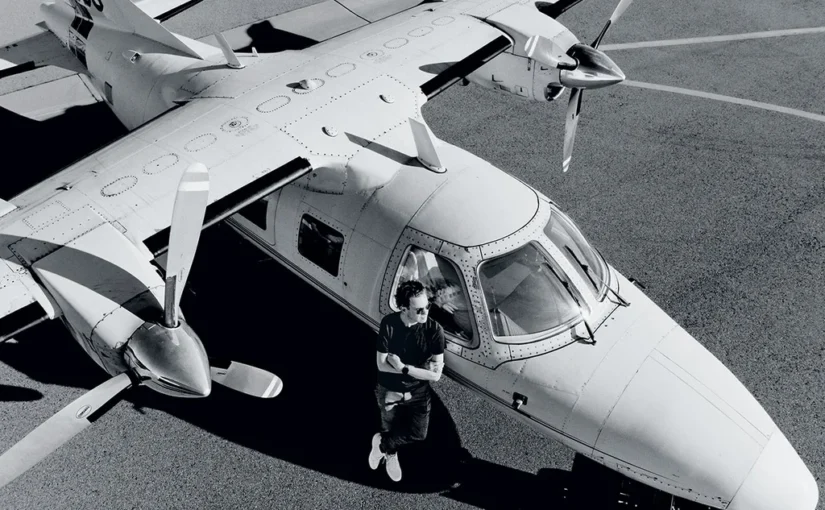
Founders’ newest status symbol? Getting a pilot’s license to fly their own plane
This article orginally ran on August 6, 2026 in Inc. magazine.
After graduating from high school in 2000, David Spector spent the summer working construction for his uncle in Maryland. He spent his earnings on a secret vice: flying lessons in a two-seat Cessna 152. But the dream didn’t last. “My parents caught me lying about where I’d go after work,” he recalls.
Spector went on to earn degrees from Tulane and then Sloan, after which he made partner at Sequoia Capital. He quit Sequoia, and he and his wife launched the intimate apparel brand Thirdlove, which has generated an estimated $1 billion in revenue since its inception. He then pivoted to launch Nanotrace, an oncology biotech startup.
With money in his pocket, Spector returned to his forbidden love, enrolling in flight school, earning his private pilot’s license, and, three years ago, buying a single-engine Cirrus SR22T propeller plane that he flies for fun and business. As a founder who’s passionate about aviation, he’s in good company. “Technology and entrepreneurship go hand in hand with flying,” he says.
Once a month or so, Spector meets with a couple dozen Silicon Valley owner-pilots in a gathering called Founders Who Fly, which is sometimes held at a hangar at San Carlos Airport, on the San Francisco Bay. The hangar belongs to Christian Bailey, a serial entrepreneur who learned to fly helicopters while a university student and now pilots prop planes and jets. At an event there this spring, the guests lounged on sofas that had been pulled out onto the cement floor of the hangar, chose between a Southern Rhône and a white Burgundy, and discussed seaplanes, helicopters, and safety while gazing upon a pair of shiny new bush planes that belonged to one of the attendees.
“What’s cool about pilots is that we always have something to talk about,” Spector says. “The second you learn that somebody else is a pilot, it turns into a very engaging and rather nerdy conversation. And the commonality is greater if the person also is a founder.”
Spector, Bailey, and their friends inhabit some pretty rarefied air. Fewer than 100,000 Americans fly their own aircraft. And yet founder-pilots are not hard to come by. Of the founders of the 2026 Inc. 5000 companies, 42 say they have a pilot’s license, and 29 say they own a plane.
Stripe founders Patrick and John Collison both fly Diamond DA42 twin-engine planes. (In 2016, Patrick flew one from Miami to Cuba, and in 2017, John flew one across the Atlantic.) Larry Ellison, Mike Bloomberg, and wireless network entrepreneur Craig McCaw are all pilots. And the Palo Alto-based West Valley Flying Club is one of the largest in the U.S., with 1,300 members, 62 aircraft, and 50-plus flight instructors. “A lot of our members come from the tech industry,” a staffer told me. “The technical challenge in flying appeals to engineering brains who like to figure out how things work.”
In fact, for as long as there have been airplanes to fly, technology-forward entrepreneurs have been flying them, all the way back to Wright Company co-founders Orville and Wilbur Wright in 1903.
Like a founder, a good pilot is comfortable with responsibility, the mastery of complex skills, and—above all—taking control. “These are not people who just kick the tires, light the fires, and go flying,” says Andrew Broom of the National Business Aviation Association. “They are big on checklists. They are the CEO of that airplane, and they are committed to making sure they are safe.”
Founders are also among the few who can afford flight as a hobby. Aspiring pilots typically start flying lessons in sturdy aircraft like the Cessna 152 or the four-seat Cessna 172. A beginner will usually spend about $25,000 and take about six to 12 months to earn a private pilot’s license. With experience and training, they can then move up to higher-performance aircraft.
Sometimes flying is less an extracurricular activity than a legitimate business expense. Former wakeboarder Chris Weber, founder of the Chicago-based yacht brokerage Weber Yachts, started out selling wakeboard boats and graduated to selling yachts in the Great Lakes region. The boats were widely scattered, and so were his customers. “You do everything you can to put deals together, and you find out that the right boat for your customer is in Ohio or Northern Michigan or Tennessee,” he says. “I’m not a very patient person. I’m Type A. And during that first eight-hour drive, I was like, ‘There’s got to be a better way to do this.’ So I went to the local airport and took a flight lesson.”
Weber’s first plane was a Cirrus SR22, a single-engine, piston-powered prop plane that seats five including the pilot and cruises at up to 210 mph. When his business expanded to the East Coast and Florida, he needed more speed and longer legs, so he got an Embraer Phenom 100, a VLJ (“very light jet”) that carries eight including the pilot and cruises at up to 449 mph. “It gets us to South Florida in about two hours and 45 minutes,” he says.
As with boats and cars, no matter how nice a plane is, its owner will inevitably find nicer models a little higher up the price spectrum. Though the FAA requires bigger and faster planes to have a flight crew of at least two, that’s a hurdle that can be overcome. Some owners fly with a professional co-pilot so that there’s someone in the seat next to them, but, says Jeff Habib, co-founder of the boutique aviation brokerage firm Intercontinental Aircraft Group, based near Lake Tahoe in Nevada, “they probably take off, fly the plane en route, and land it themselves.”
Not everyone is set on bigger, faster, farther. A pilot’s license opens the door to many kinds of aircraft, like amphibious planes, for fly-fishing on remote rivers and lakes; gliders, for soaring noiselessly amid the clouds; and antique warplanes, for connecting to the past.
Teresa Nguyen, an assistant professor of anesthesiology at Stanford and co-founder of ProofAI, a Stanford initiative taking AI and robotics into clinical care, keeps her head on straight by flying helicopters. “While flying requires constant vigilance and intuition, it is a form of meditation,” she says. “Looking down at the landscapes and the life below, it strikes me how beautiful the earth is and how small we really are.” Someday, she hopes to set up an emergency medical air transport system in her native Vietnam, a country where the helicopter still triggers memories of war.
Of course, unexpected weather or a mechanical malfunction can turn a calm flight into a crisis in seconds. “Flying doesn’t require fearlessness,” Nguyen says. “It requires courage.” Staying cool, troubleshooting, and leaning on one’s training in the face of mortal danger make the difference. And those who’ve been through a scare share a quiet, well-earned pride.
Ultimately, many founder-pilots say, the sense of peace and philosophical remove from the mundane stressors of running a company outweighs the inherent risk. Jason Middleton, founder and CEO of the private aircraft management company Silver Air, based in Santa Barbara, California, says that whether he’s flying for business or pleasure, being at the controls is “one of my most peaceful times.”
Plus, it’s impressive and adventurous. “It’s just cool to be a pilot,” Middleton says.
The Bottom Line of Learning to Fly
Pilots typically start their flight training in single-engine propeller planes like the Cessna 172 before potentially moving up to more complicated, higher-performance prop planes like the Cirrus SR22. From there, it’s a big step up in performance to small jets like the Phenom 100. More complex jets like the Gulfstream G650, the Rolls-Royce of the sky, require a flight crew of two. Some pilots prefer turboprops, which use turbine engines to drive their propellers. Turboprops generally fly slower than jets but are more fuel efficient and can land on rougher, shorter strips. “The Pilatus PC-12 is like an SUV,” says Habib of Intercontinental Aircraft Group. “People like to load them up with camping gear or motorcycles or kayaks and fly to remote areas like Idaho.”
Paying the Bills
It should come as no surprise that owning and flying your own personal aircraft costs a lot of money. The most expensive single-pilot jets cost around $16 million new, but that’s just for the plane itself. To fly it, you have to also pay for fuel, maintenance, insurance, landing fees, and storage, which together can lift the operating cost to $1,500 to $2,000 per hour for small jets. “It will shock you how much it costs,” says Weber of Weber Yachts. “If you’re looking at private aviation and you’re trying to cost-justify it, you should probably stop.”
Training
Many amateur pilots get their initial flight training either at flying clubs or at one of the thousands of small airports scattered across the country where businesses called fixed-base operators (FBOs) provide flying lessons and other services, like aircraft rental and fuel. With planes and instructors costing on the order of $250 per hour, and students requiring at least 40 hours of flight time, getting a license can cost about $25,000. “I encourage people who are starting out to try different instructors and learn the best things from each of them,” says Bailey of Founders Who Fly.
Reading the Fine Print
Some founders face legal hurdles to flying that others don’t. Boards or VCs may require key-person clauses in employment contracts that forbid them from flying an aircraft alone. And some companies carry key-person insurance, which can be expensive. Check before you take that first flight lesson.
Having Fun
For many pilots, the journey is the destination: The thrill of being free among the clouds is exhilarating in itself. For others, the appeal is arriving in style. Among the favorite touchdowns for private jet owners are the Kentucky Derby, the Super Bowl, and Davos. Some luxury resorts, including Amanpulo in the Philippines, have runways. But the ultimate destination for a true aviation-head is EAA AirVenture, a.k.a. Oshkosh, the world’s largest air show. Every year, some 10,000 aircraft make the pilgrimage to rural Wisconsin, arriving in such numbers that the runways are painted with rows of colored dots so multiple aircraft can touch down on a single runway at once. “I go every year,” Spector says.