This article originally ran on September 30, 2026 in New York magazine.
The FlyDubai 737 MAX that almost crashed on Wednesday plummeted three miles in less than a minute and came so close to breaking the sound barrier that aerodynamic forces ripped off part of the plane’s rudder. In about a minute the plane would have hit the desert 250 miles southeast of Tel Aviv. Instead, passengers managed to subdue the attacker, while two pilots traveling in the passenger cabin regained control of the plane and landed it safely at Tabuk, Saudi Arabia.
“It’s a miracle this aircraft survived, but let’s give credit to the two pilots who when they entered the cockpit found a badly configured aircraft headed for certain death,” says Mary Schiavo, a former Inspector General of the Department of Transportation who now practices aviation law at Motley Rice.
FlyDubai Flight 1073 had taken off from Dubai at 7:05am local time and climbed to 32,000 feet as it flew over the Nafud desert of northern Saudi Arabia, on its way to Tel Aviv. Two hours into the flight, as it approached the border of Jordan, one passenger said he heard someone shouting “Allahu Akbar”just before the plane nosed suddenly downward.
According to Israeli news media, one of the flight’s pilots, a citizen of Oman, stabbed the captain, a 39-year-old Indian national named Smit Machchhar, and pushed the controls forward. The plane quickly lost altitude as it accelerated to nearly the speed of sound. Parts of the aircraft might already have been supersonic, creating a sonic boom audible to anyone listening in the desert below.
It’s extremely dangerous for the 737 Max to operate at such speeds, which are well beyond what the plane was designed for. “The drag is immense,” says Tony Farina, a professor at Embry-Riddle Aeronautical University who has worked on the aerodynamics of subsonic and supersonic flight. Then, he says, there’s flutter, a rapid “movement back and forth” that can cause an aircraft’s flight control surfaces to break off.
That’s exactly what happened to Silk Air Flight 185, a 737 that went into a steep dive over the island of Sumatra, Indonesia in 1997. U.S. investigators later concluded that one of the pilots had put the plane into a fatal dive. It, too, nearly reached the speed of sound, and the force of the airflow ripped off a major portion of its tail, including part of its rudder. The ensuing impact shredded the airframe into confetti-sized pieces and killed everyone aboard.
Another aircraft that lost pieces to aerodynamic pressure was American Airlines Flight 587, which encountered wake turbulence while taking off from New York’s JFK airport in 2001. One of the pilots overreacted and repeatedly pressed too hard on the rudder pedals, causing the rudder to swing violently. The entire vertical stabilizer detached, and the plane plummeted to a fiery impact. There were no survivors.
FlyDubai 1073 was also shredded by the intense forces of the supersonic slipstream: a major part of the rudder was ripped off. And that wasn’t its only problem. With one pilot badly wounded, and the other apparently intent on suicide, the plane lurched and swung as passengers shouted, shrieked and prayed. At its moment of peak velocity, it was only about a minute from hitting the ground.
But unlike the previous disasters, Wednesday’s incident had an improbably happy ending.
As the pilots struggled, passengers using the lavatory heard the commotion, and a group of them managed to break into the cockpit. “The pilot who was stabbed was simply very close to the door, so it was hard for us to open it,” said one of the passengers, Yaniv Hayoun, later that day. “But before he collapsed” he managed to open the door, Hayoun added.
Along with another passenger, Hayoun entered the cockpit, grabbed the attacker, and with the help of other passengers, managed to bind him with zip ties. The attacker’s motive is not yet clear, and his name has not been released.
Hayoun then pulled the plane level using knowledge he said he’d gained while watching Air Crash Investigation (broadcast as Mayday in the US) before handing over control to two FlyDubai pilots who had been seated in the passenger cabin.
With the plane once more at level altitude, the new fly crew continued toward Israel at about 15,000 feet and briefly crossed into Jordan. Then, for reasons that are not yet clear, the plane did a 180 and flew back into Saudi Arabia, landing at Tabuk, an airfield that is used for both military and civil aviation.
Videos circulating on social media show passengers on the flight giving medical attention to both pilots, one of them tied up, as they lie bloodied on the floor near the cockpit.
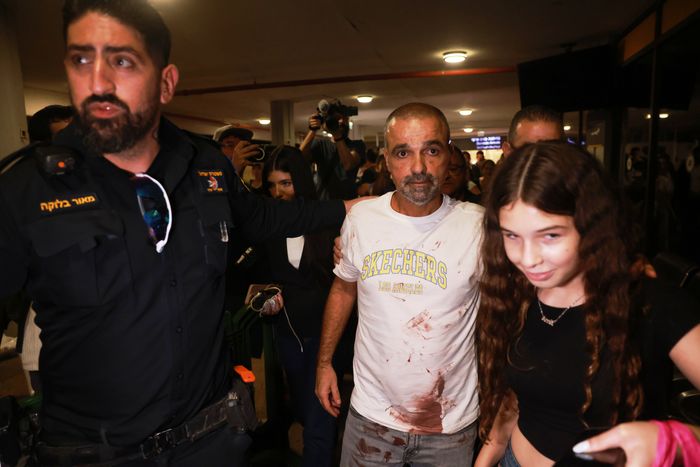
After the aircraft landed, Saudi medical workers provided emergency care to the pilots and injured passengers. They were soon flown back to Israel, where they were met with a rapturous reception. Hayoun, still wearing a blood-spattered white t-shirt, was ushered into a televised meeting with Israeli Prime Minister Benjamin Netanyahu.
“You are the hero,” Netanyahu told him. “We are a nation of lions, a nation like a lioness. I look at you and I see a lion, and I see a great hero. Simply unbelievable what you did.”
Netanyahu said that after being stabbed, the captain managed to click open the door to let his rescuers in. “My salute to the Indian pilot Captain Smit Machchhar for his extraordinary bravery. Despite being stabbed and seriously injured, he fought back, resisted, opened the cockpit door, and enabled passengers and crew to overpower the attacker — preventing a catastrophic mid-air disaster,” he wrote on X.
An Israeli dentist, Dr. Shota Musayev, was the only doctor on the plane. He rushed into the cockpit when he heard the commotion and helped save the life of the captain by stopping his bleeding and stabilizing his blood pressure. “These were very hard moments, but together with a few brave people on the plane, we managed to avert a situation that was very close to a disaster,” he said.