A heat-shield expert has major worries about Artemis II.
This article appeared in New York magazine’s Intelligencer section on March 31, 2026.
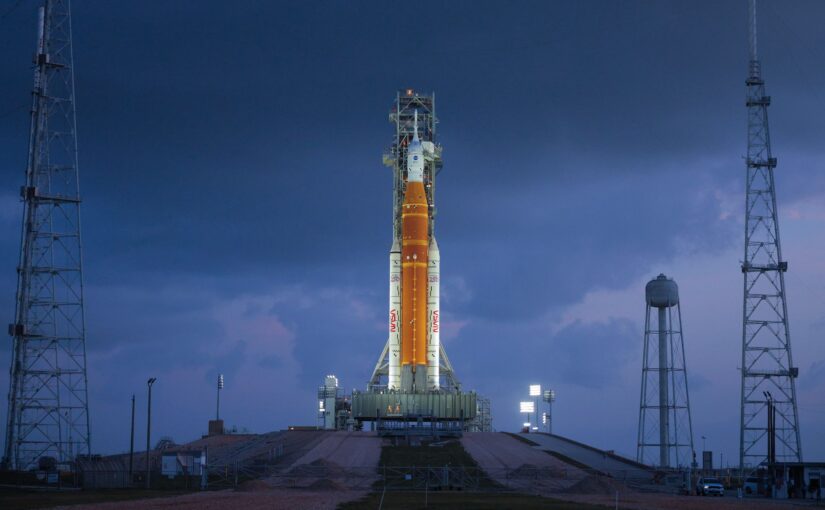
Some time during the first week of April, a 322-foot NASA rocket is scheduled to blast off from the Kennedy Space Center and soar deep into outer space, carrying its crew of four astronauts farther from Earth than humans have been in half a century. The Orion space capsule will loop around the moon, passing within 5,000 miles of the cratered surface, and then return to Earth. Turning its heat shield to the upper atmosphere, it will use aerodynamic braking to slow from a speed of 25,000 mph to just 300 mph, at which point it will deploy parachutes and splash down in the Pacific. Humanity will have returned to the moon and come home safely again.
That’s what NASA’s experts say will happen, anyway.
A guy on the internet disagrees.
Charles Camarda, a 73-year-old retiree living in Virginia, has been posting on LinkedIn and X, saying NASA has miscalculated and the Artemis IIrocket could fail catastrophically. To be clear, he is one guy, posting as a private citizen, with no institutional backing and no notable public figures standing by his side. It’s just him, one of a bazillion lone voices on the internet trying to set the world straight.
But one thing is different about Camarda that sets him apart from all those other dudes and makes his quixotic quest worth paying attention to: There is not a single person on Earth more qualified on this particular subject than he is.
“People need to listen to Charlie because he knows what he’s talking about,” says Eileen Collins, the former astronaut who made history as the first female commander of a space-shuttle mission. “He’s a high-integrity person, and his technical background is very deep.”
The subject Camarda is the world’s leading expert on is thermal protection systems, also known as heat shields, in particular the question of whether they’re capable of keeping human beings from being killed by the heat and violence of reentry from space into Earth’s atmosphere.
Born in Queens, Camarda got his Ph.D. in aerospace engineering from Virginia Polytechnic in 1990 and then was hired by NASA, where he studied thermal protection systems for space shuttles before joining the astronaut program in 1996.
Camarda’s expertise would prove timely. On February 1, 2003, Space Shuttle Columbia disintegrated as it reentered Earth’s atmosphere, killing all seven astronauts onboard. It turned out a chunk of protective foam had fallen off the main fuel tank during takeoff and hit the thermal protection material on the leading edge of the spacecraft’s left wing. It left a hole the size of a pizza box, and during reentry hot gases entered the gap and melted the internal structure, causing it to break up.
The next scheduled mission was scrapped. In its place, NASA put Collins in charge of a test flight that would determine whether the shuttle could safely be returned to regular use. Having a heat-shield expert in the crew would be invaluable. “I wanted him on my crew,” Collins says of Camarda. Having worked with him before, she’d been impressed by both his integrity — “He always told me the truth, and the whole truth” — and his skills: “He is a highly technically capable person with a deep experience in heat shields.”
Sure, he could have provided his expertise from the ground, Collins avers, “but I wanted him to go with me. The fact that he is in a position where his life is on the line, he’s got skin in the game.”
So Camarda, who normally wouldn’t have been scheduled to fly for several more years, was moved ahead in line.
Space-shuttle mission STS-114 blasted off from the Kennedy Space Center on July 26, 2005, with Camarda aboard as mission specialist five. Once they were in space, he led a team inspecting the heat-shield tiles for signs of damage using a camera mounted at the end of a robotic arm. The crew then maneuvered close to the International Space Station so astronauts there could take high-resolution photos of the shuttle’s underside. The images were then downloaded to mission control, where a team examined them and spotted a problem.
Pieces of material called “gap filler,” which normally serve to absorb vibrations between the heat shield’s thermal tiles, had come loose owing to faulty glue and were now sticking up out of the otherwise smooth surface of the shuttle’s belly.
Collins asked Camarda what he thought they should do. Camarda said he didn’t know and then called two engineers at NASA’s Langley Research Center, Scott Berry and Tom Horvath, for advice. “Tom said, ‘Charlie, you really need to do an emergency EVA’ — extravehicular activity, a.k.a. a space walk,” Camarda recalls.
The engineers were afraid that if the gap fillers were left as they were, they could rip out during reentry and possibly pull out some tiles, too, leaving the underlying structure unprotected from the blowtorch heat. It would be the Columbia disaster all over again. “A lot of people throughout the shuttle program were very nervous,” Collins recalls. “Our families were nervous as hell.”
Crew members Soichi Noguchi and Stephen Robinson donned space suits and went out and fixed the problem. Inside the shuttle, the mood was tense. “There were a lot of people that were very nervous about that,” Collins says. “You want to pull on that gap filler and you really, really don’t want that tile to come with it. I told Steve before he went out on his space walk, ‘Do not pull out a tile. Please do not.’ And he said, ‘Don’t worry, boss.’”
Robinson did not pull out a tile. The repair job worked, and the crew returned safely to Earth. The space shuttle flew 27 more missions, until the International Space Station was finished, and then the program was terminated. For nine years, until the SpaceX Falcon 9 entered service, the United States could send astronauts into space only by buying seats on Russian rockets.
As part of its effort to revive its manned-spaceflight program, NASA in 2005 kicked off a project called Constellation that aimed to return the U.S. to the moon by 2020. It included a giant rocket, the Ares V, as well as a space capsule, the Orion. The program was killed by the Obama administration in 2010, then revived in a different form in 2019 under the name Artemis. Now the goal was to put an astronaut on the moon’s surface by 2024.
As is often the case, the project was beset by delays and cost overruns. Finally, on November 16, 2022, the first Artemis rocket took off. For safety, it flew without a crew. The capsule circled once around the moon, then returned to Earth, reentered the atmosphere, and floated to the splashdown in the Pacific. The mission succeeded flawlessly — with one troubling exception. When NASA engineers examined the bottom of the capsule, they found chunks of the heat shield had been torn off, a process called “spalling.”
That wasn’t supposed to happen. An ablative heat shield is designed to erode steadily and evenly as it plows through the atmosphere so a comfortable margin of protective material remains between the human crew and the fiery plasma outside.
The problem with the Artemis heat shield was twofold, Camarda says. First, its composite material was too dense, so the gas contained inside the material could not gradually work its way out as it was heated. Instead, the gas was trapped and expanded explosively when it got too hot, blasting out hunks of material.
Another issue was how the material was used. Apollo heatshields were made from a honeycomb of hundreds of thousands of pieces of resin so that cracks couldn’t propagate too far. “In the new version,” Camarda says, “to save money and time, they just use big sheets of it.” As a result, if a crack occurs, it can propagate a long distance and large chunks can come off.
If that happens when Artemis II reenters the atmosphere, the heat shield could fail entirely. The crew inside would risk incineration.
Camarda reached out to NASA officials and begged them to let him work on the problem. “I said, ‘Let me put together a team to understand what’s happening,’ because I knew NASA didn’t have the expertise to solve this problem,” he says. “I would have gone to Sandia, gone to the national labs, gone to academia, and put multiple teams together to try to come up with an understanding of the physics of the problem.”
NASA passed on his offer. Instead, it convened its own panel of outside experts and decided that, while they couldn’t fully understand what had caused the spalling, they could still safely carry out the mission by changing the way the spacecraft reentered the atmosphere.
Determined to fight back however he could, Camarda started posting about the problem on X and LinkedIn and added an epilogue to his 2024 book about NASA organizational failure, Mission Out of Control. Among the few voices joining him on social media was Ed Pope, an expert in high-temperature materials. Eventually, Camarda became too annoying to ignore. This past January, the new NASA administrator, Jared Isaacman, invited him and two journalists to meet with the Artemis team at NASA headquarters to discuss the issue. At the meeting, NASA officials admitted they still didn’t fully understand the spalling problem but asserted that the capsule could survive even if the heat shield partially failed.
Camarda came away from the meeting unconvinced. “It was basically a setup,” he says. He still believes, given the heat shield’s known problems, that Artemis is too dangerous to carry astronauts into space. And he says that as someone who has calculated the risk of spaceflight for himself.
When it first went into service the space shuttle was expected to have a failure rate of one in 100,000 launches. By the time Camarda strapped in, it had had already failed twice in 113 launches, for a failure rate of one in 56.5. He estimates the crew of the Artemis II faces even worse odds — somewhere between one in 20 and one in 50.
Camarda knows the Artemis astronauts are aware of the risks. He also knows the mentality of astronauts. He understands the motivation to fly, and he’s not surprised they have decided to proceed regardless.
He’s just hoping that he’s wrong. After all, a one-in-20 chance of catastrophe means there’s a 95 percent chance that his fears will prove unfounded.
For now, he’s resigned. “We tried, but there was too much pressure to launch,” Camarda wrote to me last week as the Artemis II crew began its final round of preparations at the Kennedy Space Center. “All we can do is pray.”
Tiles were damaged on every one of the shuttle missions. Columbia failed because of a hole on the edge of the wing, not damaged tiles. Space flight was dangerous, is dangerous, and will always be dangerous. It is not without risks. Everything has risks. The more ambitious the endeavor, the higher the risk involved. NASA has people devoted to their mission in the same way that this guy was devoted to his. We will see if they are successful. I am looking forward to a successful flight.